Renewed Motion for Counsel
Motion Images
Motion Text
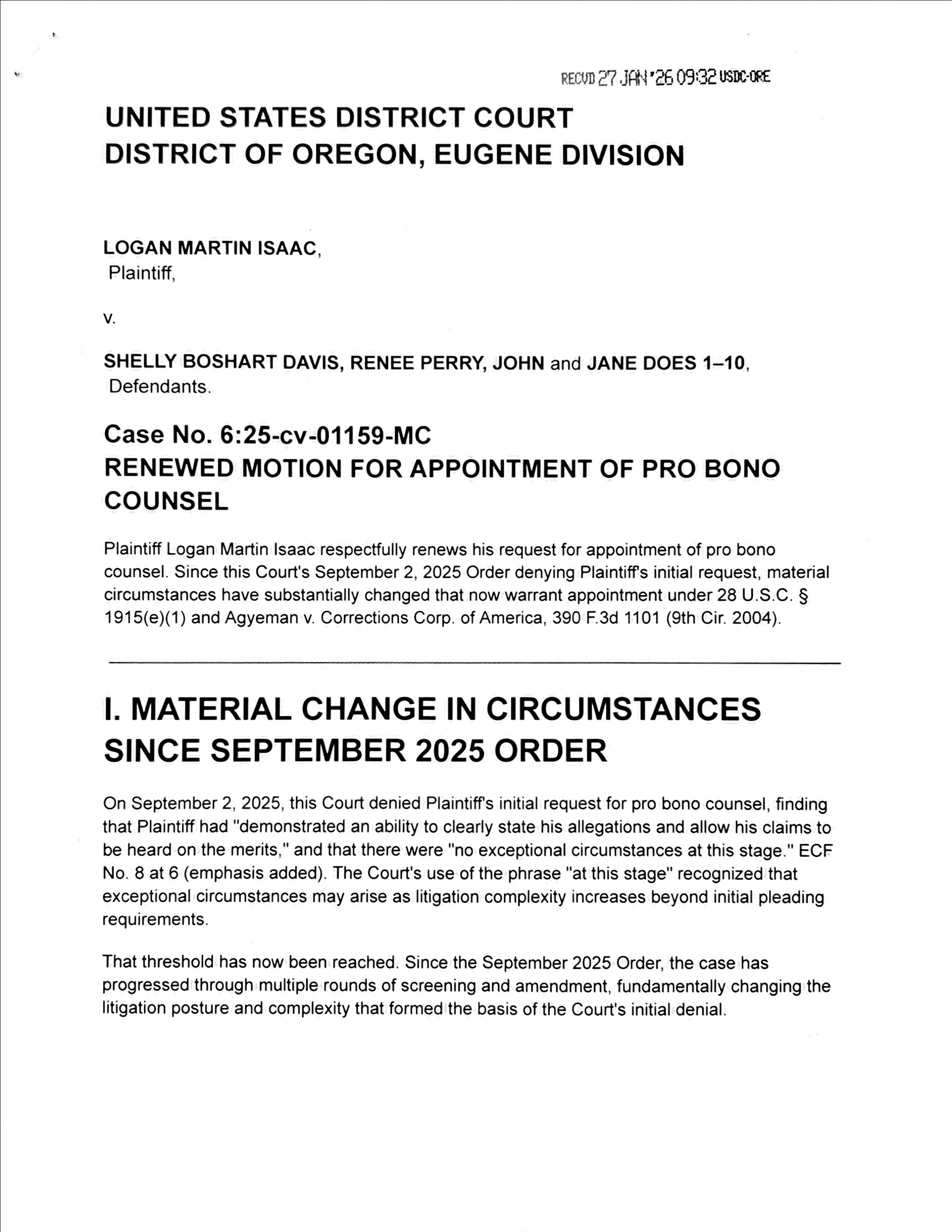
Plaintiff Logan Martin Isaac respectfully renews his request for appointment of pro bono counsel. Since this Court's September 2, 2025 Order denying Plaintiff's initial request, material circumstances have substantially changed that now warrant appointment under 28 U.S.C. § 1915(e)(1) and Agyeman v. Corrections Corp. of America, 390 F.3d 1101 (9th Cir. 2004).
I. MATERIAL CHANGE IN CIRCUMSTANCES SINCE SEPTEMBER 2025 ORDER
On September 2, 2025, this Court denied Plaintiff's initial request for pro bono counsel, finding that Plaintiff had "demonstrated an ability to clearly state his allegations and allow his claims to be heard on the merits," and that there were "no exceptional circumstances at this stage." ECF No. 8 at 6 (emphasis added). The Court's use of the phrase "at this stage" recognized that exceptional circumstances may arise as litigation complexity increases beyond initial pleading requirements.
That threshold has now been reached. Since the September 2025 Order, the case has progressed through multiple rounds of screening and amendment, fundamentally changing the litigation posture and complexity that formed the basis of the Court's initial denial.
A. The Case Has Advanced Beyond the Initial Pleading Stage
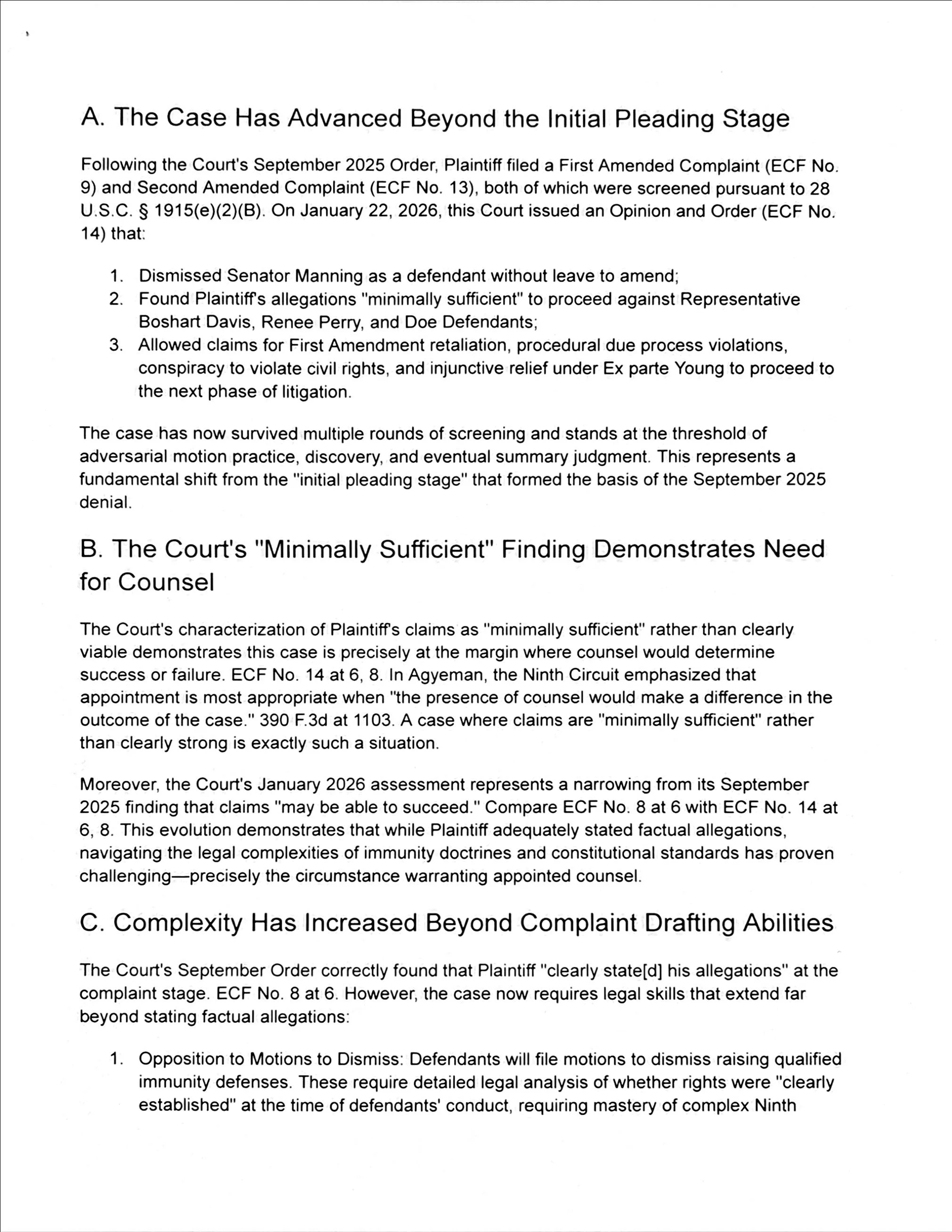
Following the Court's September 2025 Order, Plaintiff filed a First Amended Complaint (ECF No. 9) and Second Amended Complaint (ECF No. 13), both of which were screened pursuant to 28 U.S.C. § 1915(e)(2)(B). On January 22, 2026, this Court issued an Opinion and Order (ECF No. 14) that:
- Dismissed Senator Manning as a defendant without leave to amend;
- Found Plaintiff's allegations "minimally sufficient" to proceed against Representative Boshart Davis, Renee Perry, and Doe Defendants;
- Allowed claims for First Amendment retaliation, procedural due process violations, conspiracy to violate civil rights, and injunctive relief under Ex parte Young to proceed to the next phase of litigation.
The case has now survived multiple rounds of screening and stands at the threshold of adversarial motion practice, discovery, and eventual summary judgment. This represents a fundamental shift from the "initial pleading stage" that formed the basis of the September 2025 denial.
B. The Court's "Minimally Sufficient" Finding Demonstrates Need for Counsel
The Court's characterization of Plaintiff's claims as "minimally sufficient" rather than clearly viable demonstrates this case is precisely at the margin where counsel would determine success or failure. ECF No. 14 at 6, 8. In Agyeman, the Ninth Circuit emphasized that appointment is most appropriate when "the presence of counsel would make a difference in the outcome of the case." 390 F.3d at 1103. A case where claims are "minimally sufficient" rather than clearly strong is exactly such a situation.
Moreover, the Court's January 2026 assessment represents a narrowing from its September 2025 finding that claims "may be able to succeed." Compare ECF No. 8 at 6 with ECF No. 14 at 6, 8. This evolution demonstrates that while Plaintiff adequately stated factual allegations, navigating the legal complexities of immunity doctrines and constitutional standards has proven challenging—precisely the circumstance warranting appointed counsel.
C. Complexity Has Increased Beyond Complaint Drafting Abilities
The Court's September Order correctly found that Plaintiff "clearly state[d] his allegations" at the complaint stage. ECF No. 8 at 6. However, the case now requires legal skills that extend far beyond stating factual allegations:
Opposition to Motions to Dismiss: Defendants will file motions to dismiss raising qualified immunity defenses. These require detailed legal analysis of whether rights were "clearly established" at the time of defendants' conduct, requiring mastery of complex Ninth Circuit precedent on First Amendment retaliation, procedural due process, and conspiracy liability. The qualified immunity analysis involves multi-step tests that are beyond the scope of factual pleading.
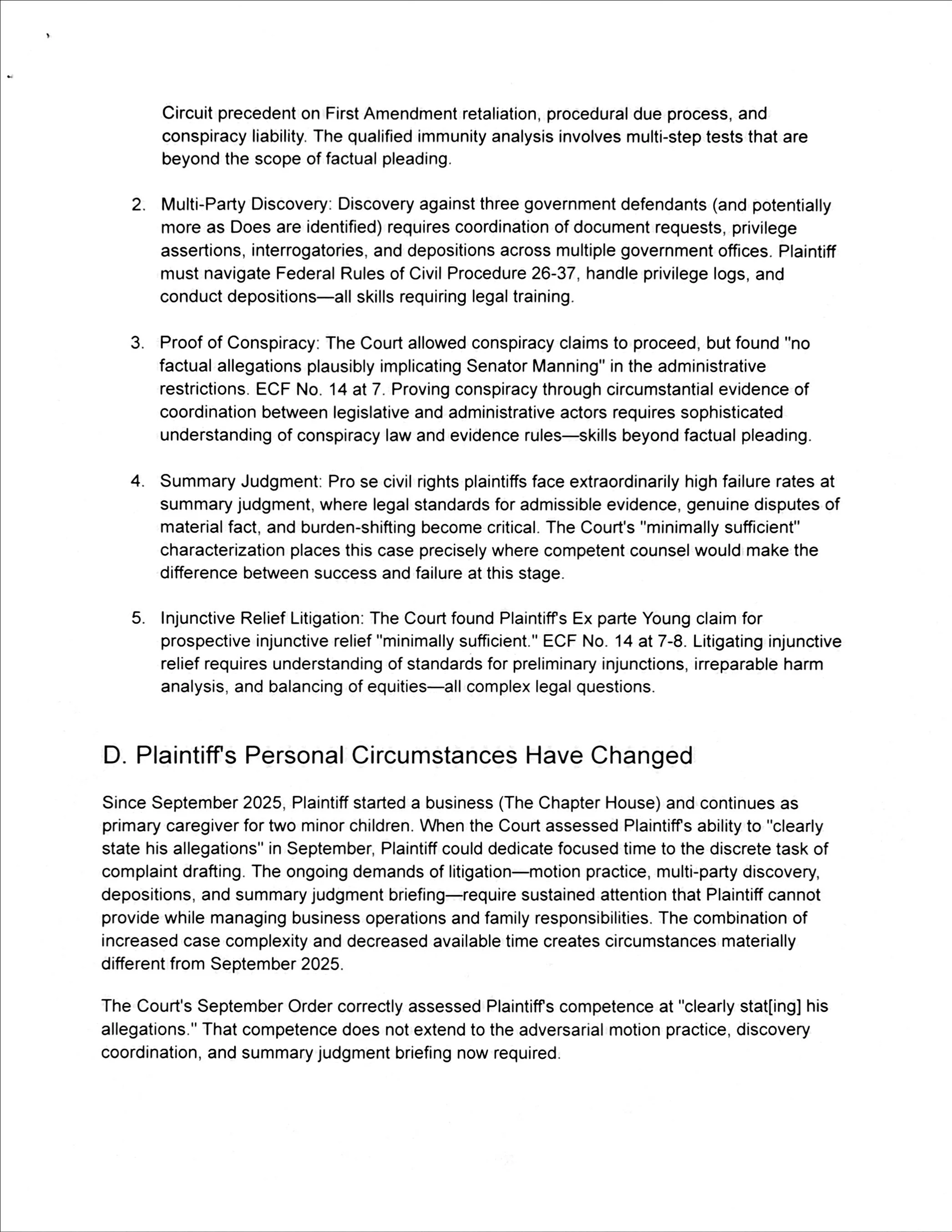
Multi-Party Discovery: Discovery against three government defendants (and potentially more as Does are identified) requires coordination of document requests, privilege assertions, interrogatories, and depositions across multiple government offices. Plaintiff must navigate Federal Rules of Civil Procedure 26-37, handle privilege logs, and conduct depositions—all skills requiring legal training.
Proof of Conspiracy: The Court allowed conspiracy claims to proceed, but found "no factual allegations plausibly implicating Senator Manning" in the administrative restrictions. ECF No. 14 at 7. Proving conspiracy through circumstantial evidence of coordination between legislative and administrative actors requires sophisticated understanding of conspiracy law and evidence rules—skills beyond factual pleading.
Summary Judgment: Pro se civil rights plaintiffs face extraordinarily high failure rates at summary judgment, where legal standards for admissible evidence, genuine disputes of material fact, and burden-shifting become critical. The Court's "minimally sufficient" characterization places this case precisely where competent counsel would make the difference between success and failure at this stage.
Injunctive Relief Litigation: The Court found Plaintiff's Ex parte Young claim for prospective injunctive relief "minimally sufficient." ECF No. 14 at 7-8. Litigating injunctive relief requires understanding of standards for preliminary injunctions, irreparable harm analysis, and balancing of equities—all complex legal questions.
D. Plaintiff's Personal Circumstances Have Changed
Since September 2025, Plaintiff started a business (The Chapter House) and continues as primary caregiver for two minor children. When the Court assessed Plaintiff's ability to "clearly state his allegations" in September, Plaintiff could dedicate focused time to the discrete task of complaint drafting. The ongoing demands of litigation—motion practice, multi-party discovery, depositions, and summary judgment briefing—require sustained attention that Plaintiff cannot provide while managing business operations and family responsibilities. The combination of increased case complexity and decreased available time creates circumstances materially different from September 2025.
The Court's September Order correctly assessed Plaintiff's competence at "clearly stat[ing] his allegations." That competence does not extend to the adversarial motion practice, discovery coordination, and summary judgment briefing now required.
II. EXCEPTIONAL CIRCUMSTANCES NOW EXIST UNDER AGYEMAN
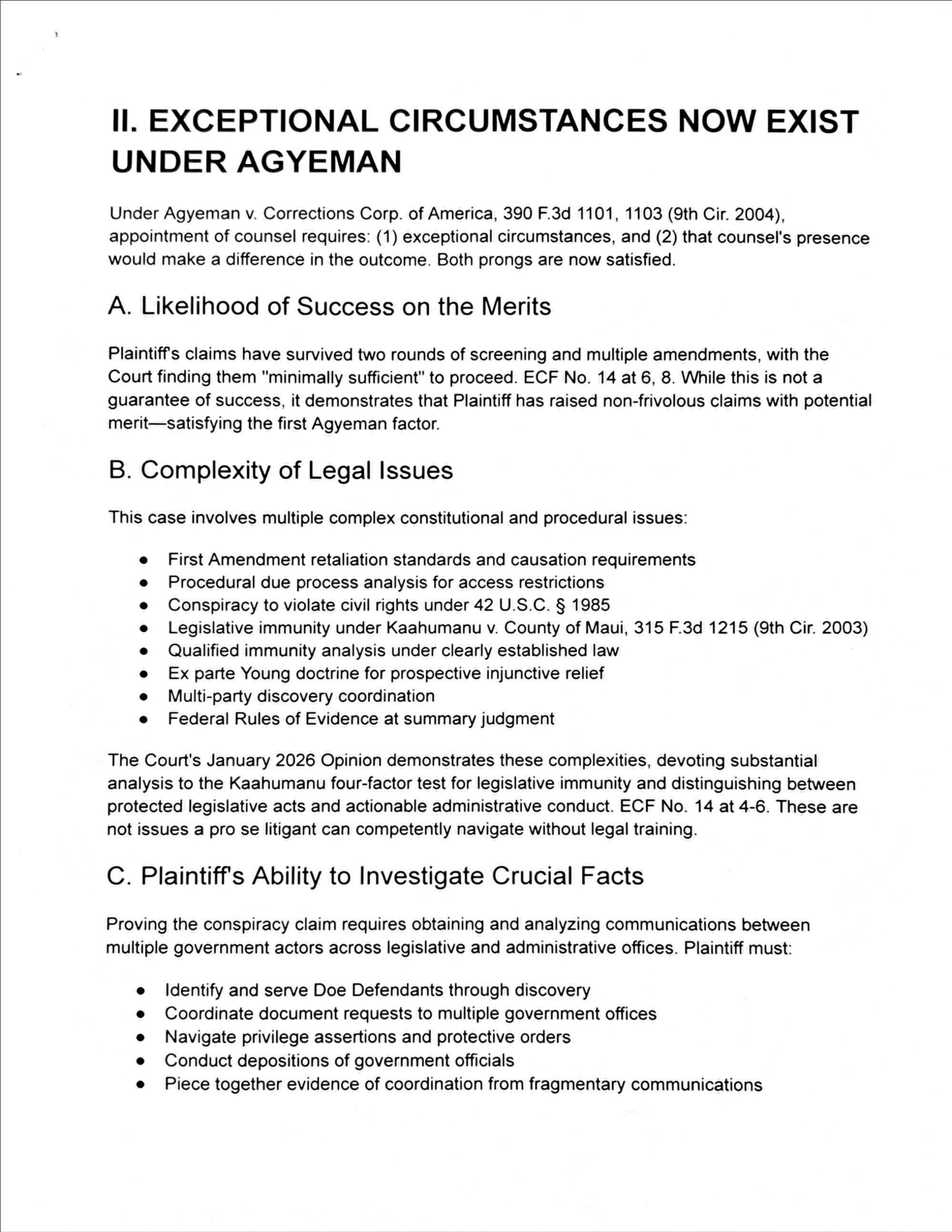
Under Agyeman v. Corrections Corp. of America, 390 F.3d 1101, 1103 (9th Cir. 2004), appointment of counsel requires: (1) exceptional circumstances, and (2) that counsel's presence would make a difference in the outcome. Both prongs are now satisfied.
A. Likelihood of Success on the Merits
Plaintiff's claims have survived two rounds of screening and multiple amendments, with the Court finding them "minimally sufficient" to proceed. ECF No. 14 at 6, 8. While this is not a guarantee of success, it demonstrates that Plaintiff has raised non-frivolous claims with potential merit—satisfying the first Agyeman factor.
B. Complexity of Legal Issues
This case involves multiple complex constitutional and procedural issues:
- First Amendment retaliation standards and causation requirements
- Procedural due process analysis for access restrictions
- Conspiracy to violate civil rights under 42 U.S.C. § 1985
- Legislative immunity under Kaahumanu v. County of Maui, 315 F.3d 1215 (9th Cir. 2003)
- Qualified immunity analysis under clearly established law
- Ex parte Young doctrine for prospective injunctive relief
- Multi-party discovery coordination
- Federal Rules of Evidence at summary judgment
The Court's January 2026 Opinion demonstrates these complexities, devoting substantial analysis to the Kaahumanu four-factor test for legislative immunity and distinguishing between protected legislative acts and actionable administrative conduct. ECF No. 14 at 4-6. These are not issues a pro se litigant can competently navigate without legal training.
C. Plaintiff's Ability to Investigate Crucial Facts
Proving the conspiracy claim requires obtaining and analyzing communications between multiple government actors across legislative and administrative offices. Plaintiff must:
- Identify and serve Doe Defendants through discovery
- Coordinate document requests to multiple government offices
- Navigate privilege assertions and protective orders
- Conduct depositions of government officials
- Piece together evidence of coordination from fragmentary communications
These tasks require legal expertise in discovery practice that extends well beyond the complaint-drafting skills the Court found adequate in September 2025.
D. Plaintiff's Ability to Present Evidence
At summary judgment, Plaintiff must marshal evidence in admissible form, respond to defendants' evidence, file supporting declarations, and brief complex legal standards. Pro se litigants notoriously struggle at this stage, even when claims survive pleading challenges.
E. Presence of Conflicting Testimony
Once defendants respond to discovery and file declarations in support of summary judgment, there will inevitably be conflicting accounts of:
- Whether Plaintiff's conduct on January 27, 2025 was threatening
- The reasons for imposing office and Capitol restrictions
- Communications and coordination between defendants
- The decision-making process for legislative scheduling
Navigating conflicting evidence requires legal skills in marshaling evidence, impeachment, and presenting credibility issues to the factfinder.
F. Counsel Would Make a Difference in Outcome
The Court's characterization of claims as "minimally sufficient" places this case exactly where counsel would determine success or failure. Pro se civil rights plaintiffs face extremely high failure rates at summary judgment, compared to represented plaintiffs. With claims at the threshold of viability, experienced counsel's ability to conduct discovery effectively, respond to qualified immunity arguments, and present evidence at summary judgment would materially affect the outcome.
III. PLAINTIFF'S EFFORTS TO OBTAIN COUNSEL
Plaintiff has made diligent efforts to obtain counsel. In his initial motion (ECF No. 3), Plaintiff documented contacts with:
- Johnston Law Firm, P.C. (declined)
- Richard E Slezak (outside area of practice)
- OlsenDaines (declined)
- Weatherford Thompson, P.C. (declined)
Since that time, Plaintiff has continued seeking representation. The case's survival of multiple screening rounds makes it more viable for pro bono consideration, but Plaintiff's financial circumstances prevent retention of private counsel. Plaintiff receives $50,000 annually in disability compensation, supports two minor children, and has monthly expenses of approximately $5,850. ECF No. 3 at 2-3. These circumstances have not changed since the Court granted IFP status.
IV. DISTINGUISHING THE SEPTEMBER 2025 DENIAL
This motion differs from the September 2025 request in critical respects:
Timing: The September Order evaluated need "at this stage"—the initial pleading stage. The case is now past that stage and entering adversarial motion practice and discovery.
Court Findings: The Court has now made substantive rulings on immunity, conspiracy pleading requirements, and claim viability that demonstrate legal complexity beyond factual pleading.
Complexity: The skills needed have shifted from "clearly stat[ing] allegations" (which the Court found Plaintiff could do) to navigating qualified immunity, conducting multi-party discovery, and surviving summary judgment (which require legal training).
Likelihood of Success: The claims' characterization as "minimally sufficient" rather than clearly viable demonstrates this is precisely the case where counsel would affect outcome.
Plaintiff does not challenge the Court's September 2025 finding that he adequately stated his allegations. That finding was correct. But the ability to state factual allegations does not equal the ability to litigate a complex civil rights case through discovery, motion practice, and summary judgment against experienced government counsel.
V. CONCLUSION
The circumstances that justified denial in September 2025—Plaintiff's competence at the initial pleading stage—no longer apply. The case has advanced beyond that stage into a phase where legal training becomes essential. The Court's own findings that claims are "minimally sufficient" demonstrate this case is at the margin where counsel would determine success or failure.
Plaintiff respectfully requests the Court appoint pro bono counsel to represent him in this action. In the alternative, Plaintiff requests the Court refer this matter to volunteer lawyer programs familiar with civil rights litigation, including but not limited to:
- Oregon State Bar Lawyer Referral Service
- Legal Aid Services of Oregon - Civil Rights Project
- ACLU of Oregon
- Oregon Law Center
- Lewis & Clark Legal Clinic
- Disability Rights Oregon
Respectfully submitted,
[Signature]
Logan Martin Isaac
Pro Se Plaintiff
Dated: January 27, 2026